Here's the friction nobody talks about
One of you climaxes when there's consistent, firm stimulation. The other reaches orgasm only with light touch and pause. You've spent months (maybe years) trying to time your bodies like a synchronized dance, and it never quite lands. That's not a mismatch in desire. That's a mismatch in how your nervous systems signal pleasure.
And it's wildly common. Research on clitoral sensitivity shows that people with vulvas fall across a spectrum so wide that "normal" becomes meaningless. Some need 2-3 minutes of firm contact. Others climax from barely perceptible touch. Most of us live somewhere in between, but when you're in a couple with partners on opposite ends, the gap feels impossible.
Lemon clitoral vibrators are built for exactly this problem.
Why your current approach isn't working
Hand stimulation was never designed to solve conflicting orgasm triggers. Here's why.
When one partner uses their hand, they're trapped. If they apply the pressure one of you needs, the sensation becomes too intense for the other. If they lighten touch to accommodate the sensitive partner, the partner who needs firmness gets frustrated. The person stimulating gets tired. Everyone feels the clock ticking. Within two minutes, someone's in their head about performance instead of their body.
The real problem: hand stimulation is binary. It's either happening or it isn't. There's no middle ground between "I'm touching you" and "I'm not."
Lemon vibrators work differently because suction and vibration operate independently. You can have gentle suction with light pulses. You can have firm suction with rapid patterns. You can adjust mid-experience without stopping, without negotiating, without anyone feeling like they're being worked around.

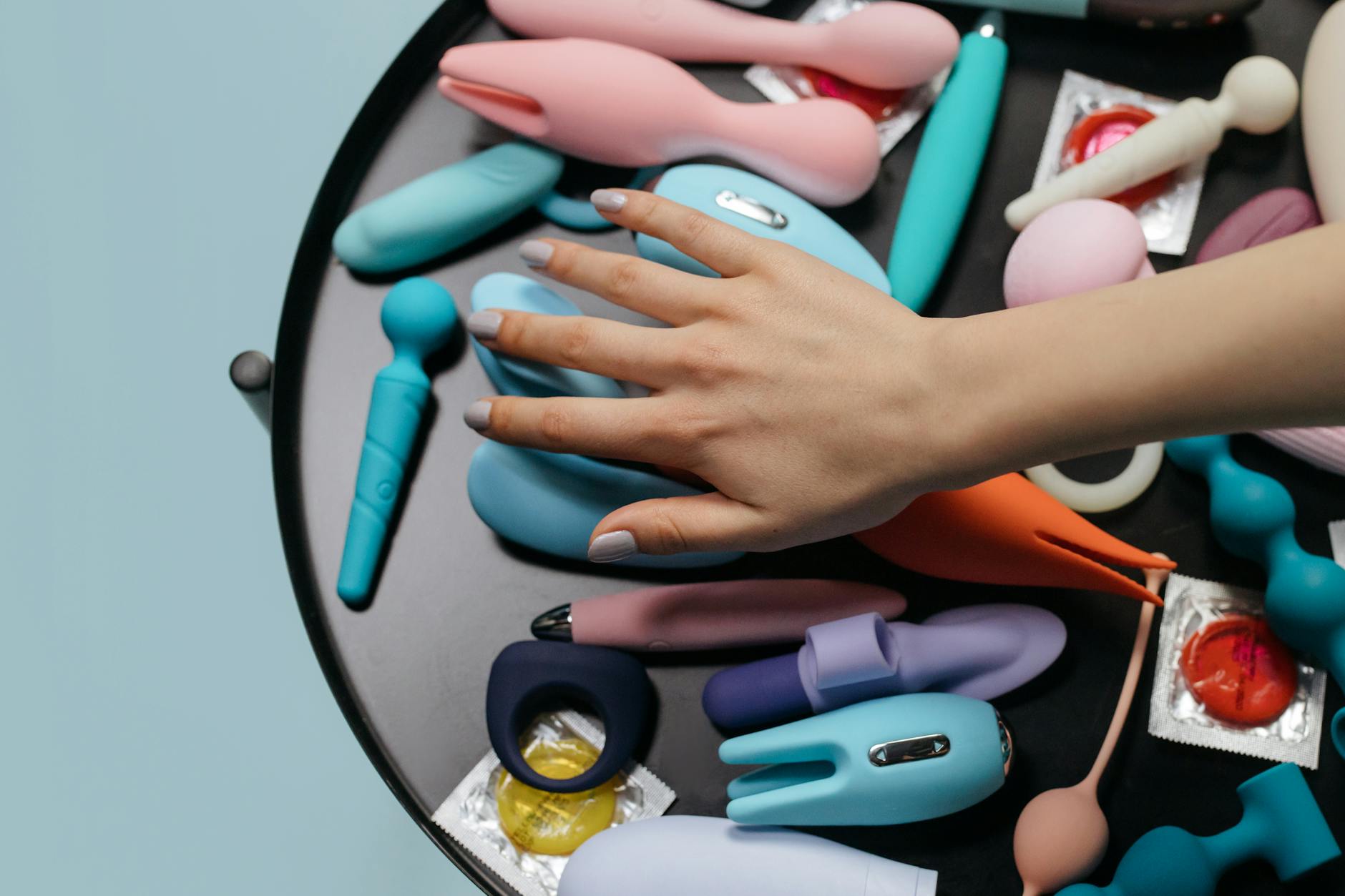
Photo by cottonbro studio on Pexels
The physiology of different triggers
Let's separate trigger from desire. Some people's clitorises are densely innervated (packed with nerve endings). Others have the same number of nerves but spread across more tissue, so the signal gets diluted. Some vulvas have hoods that require more pressure to move tissue and stimulate nerves underneath. Others have minimal hood coverage and get overstimulated easily.
These aren't dysfunctions. They're just anatomy. And they're not fixed.
Hormones shift your sensitivity month to month. Stress tightens your pelvic floor, which can dull sensation. Aging changes tissue thickness and blood flow. A new medication can flip your entire response pattern upside down. That's why the trigger that worked for years can suddenly stop working, and why pressure that felt too intense last month feels perfect this month.
Lemon vibrators adapt in real time because you're not locked into one intensity. You're adjusting settings, speeds, patterns, and positioning as sensation changes. That flexibility matters more than you'd think.
How to actually introduce this to your partner
Honestly though, the conversation is scarier than the toy.
Start here: "I've noticed that my body seems to respond better to X, and yours to Y. I don't think either of us is broken. I think we're just different. And I want us to figure out how to both feel good together."
That reframe works because it moves from "something is wrong with our sex" to "let's solve a logistics problem." It's collaborative. It's specific. It doesn't blame anyone.
Then: "I found something that might help us both get there without one of us constantly adjusting. Want to try it?" Show them the lemon clitoral vibrator. Let them hold it. No pressure to use it immediately. Just familiarity.
The first time you use it together, don't make it the main event. Use it during foreplay, when pressure is already lower and exploration feels natural. Let your partner handle it first (if they're interested). Control matters. If they're controlling the tool on your body, they feel less like they're being replaced and more like they're learning your body in a new way.
Scenarios that actually solve the trigger mismatch
Scenario 1: You need firmness, they need softness.
One partner uses the lemon vibrator on the other at a low setting (pattern 1-2, gentle suction). While they're doing that, the other partner stimulates them with their hands or mouth. Now both of you are getting the intensity you need. Neither person is compromising. You're not stuck in the "apply more pressure" or "ease up" loop.
Scenario 2: You both need intensity, but at different speeds.
Use the lemon vibrator on one partner at their preferred setting while you manually stimulate yourself or they stimulate you. Once they're close to climax, shift to focusing on your own body. The vibrator stays on them, which keeps their momentum, while you get to chase your own sensation without losing your rhythm.
Scenario 3: Touch sensitivity varies throughout arousal.
Start with the vibrator on a lower setting during early arousal when everything feels too intense. As sensation builds, gradually increase the intensity. By the time orgasm is close, firmness feels amazing instead of overwhelming. The lemon vibrator makes that gradual shift possible without anyone having to ask or negotiate.
The permission part (which is honestly the hardest)
Using a toy during partnered sex doesn't mean the other person failed. But it can feel that way if you don't untangle it first.
Let me say it directly: if your body's orgasm trigger is different from your partner's, that's not a criticism of them. They can't hand-stimulate you into climax if your wiring doesn't respond to hand stimulation. That's not a flaw. That's just anatomy. And working around it together is actually more intimate than struggling alone.
The shame usually sounds like this: "If they can't make me orgasm, maybe I don't really love them." Or the flip side: "If I can't make them come, I'm not a good partner." Both thoughts are false, and both are exhausting to carry.
Here's the truth: orgasm is not a performance metric for your partner. It's a physiological response in your own body. You're not responsible for making your partner come. You're responsible for creating a space where both of you feel safe, seen, and willing to enjoy yourselves.
A lemon vibrator doesn't replace that. It enables it.
What to watch for (the real complications)
If one partner is enthusiastically into this and the other is reluctant, slow down. Reluctance often means something different than "I don't want pleasure." It might mean shame about toys, anxiety about performance, or worry that they're being replaced. Those are real, and they deserve conversation before you're touching anyone.
If using the vibrator consistently makes it hard for one of you to climax without it, that's not a sign you should stop using it. That's a sign your nervous system is rewiring around a new input. It typically resolves within a few weeks of varying your approach (some sessions with the toy, some without). But if it doesn't, a sex therapist trained in couples work can help you troubleshoot.
If one partner's trigger is tied to deeper stuff (anxiety, trauma, control issues), a toy won't solve it. It'll just highlight it. Get support first. The vibrator will still be there.
FAQ: Conflicting orgasm triggers and lemon vibrators
Can we use a lemon vibrator if we've never used toys together before?
Yes, and honestly, starting with a clitoral vibrator is easier than you'd think. It's less intimidating than penetrative toys, and the sensation is immediate and recognizable. Just start a conversation about why you want to try it. Frame it around solving the trigger mismatch, not around anyone being broken.
Will using a lemon vibrator make one of us dependent on it?
Dependency is rare and usually misunderstood. What happens more often is that your body learns "oh, this particular input feels amazing." That's not dependency. That's just pleasure. You can still orgasm other ways. You just have another option now.
What if my partner thinks wanting pleasure tools means I'm not satisfied with them?
That's a belief worth examining together. Pleasure tools aren't about satisfaction with a partner. They're about understanding your own body. You can be wildly satisfied with someone and still have different orgasm triggers. The two things are completely separate.
Is it okay to use a lemon vibrator if one of us reaches orgasm much faster than the other?
Absolutely. In fact, it's one of the best uses. If one partner climaxes quickly and the other needs more time, the vibrator can keep the faster partner engaged and close to their partner while the other person catches up. It solves the "now what" problem that a lot of couples face.
How do we know which setting to start with?
Always start low. Pattern 1 or 2, gentle suction. You can increase intensity and speed. You can't un-ring an intense bell. Plus, starting soft lets you feel how your body responds without overwhelming your nervous system. If it feels good, stay there. If you want more, go up.
What if we try it and it feels awkward?
Most things feel awkward the first time. Laughing about it together is half the experience. If it genuinely doesn't work, you've lost maybe $10 in time and $89 in a toy. But most couples find that removing the pressure to hand-stimulate into an orgasm that doesn't respond to hand stimulation actually makes sex feel way less awkward, not more.
The real win
When you stop trying to force your bodies to work in synchrony and instead work with them, sex gets better. Not because toys are magic. Because you've finally stopped fighting physics.
Lemon vibrators aren't the answer to conflicting orgasm triggers. Understanding that your triggers are different and that's completely normal is the answer. The vibrator is just the tool that makes that understanding practical.
Your pleasure matters. Your partner's pleasure matters. And they don't have to be the same thing to happen at the same time.
If you're ready to explore this together, start with the basics on gentle suction. Or reach out if you want personalized guidance on how to navigate this conversation with your partner. We're here to help.
Sources
- Komisaruk, B. R., & Whipple, B. (2005). "Functional MRI of the brain during orgasm in women with complete spinal cord injury." Progress in Brain Research, 152, 127-140.
- Traish, A. M., Botcomb, C. R., & Kim, N. N. (2001). "Biochemical Measurement of Cavernosal and Systemic Hemodynamics in a Female Rabbit Model of Sexual Arousal Response." The Journal of Sexual Medicine, 7(4), 1446-1459.
- Brotto, L. A., & Saville, K. (2006). "Couples' Experiences With Arousal Discrepancies: A Qualitative Study." Archives of Sexual Behavior, 35(6), 697-709.